
Which Vance Book Are We In
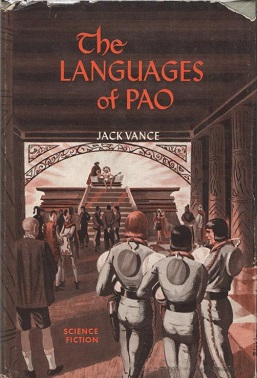
The Languages of Pao if often remembered as the book about engineering a population by engineering its language. Palafox, the Breakness wizard, takes a passive agrarian world that cannot defend itself and partitions it. Three artificial languages, three populations raised inside them. Valiant produces a warrior caste. Technicant produces industry. Cogitant produces administrators. The program is deliberate, scheduled, and attributable to a named person with stated ends.
Almost nobody remembers who actually won.
The interpreter that isn’t a product
What Pao actually has, once you read the last third of the novel past the partition, isn’t a fourth caste in any administrative sense. It’s a practice of translation that lives in people who know how to hold two incompatible grammars in one skull and move meaning between them. The groups can’t talk. That’s not a bug Palafox fixed by adding a channel; that’s the condition. The mediation is the condition’s answer, and it persists because any person who can do the holding can rebuild it from nothing after the specific tools that carried it are gone.
Pastiche starts as play. A workaround, something the mediators do because the partition made it necessary and because slack existed where the program hadn’t budgeted any. Then it becomes load-bearing. It unifies the population against the engineering being imposed on them and it lets them govern themselves.
Palafox designed three languages and got four. That’s the part worth sitting with. His error isn’t in the mechanism, because the mechanism worked. Pao stopped being defenseless. His error is in the boundaries of his own intervention, which is a much harder thing to be right about than a mechanism. He is responsible for the initial conditions and he does not control the synthesis, and Vance refuses to collapse those two facts into one.
The surplus wasn’t noise. It followed from the shape of the intervention. Partition a population and you create boundaries, boundaries require crossing, and the crossers develop a competence nobody wrote down.
The current version of the condition
The current version of that condition is two models that don’t share a weight space. One is open, uncensored, runs anywhere, anyone can inspect it. Think of a Qwen-class or equivalent. The other is closed, enterprise-gated, restricted by licensing and by whatever usage taxonomy the gatekeeper has decided to publish, say a Claude Fable 5.1-class or whatever number comes next. Neither can be used alone to do everything the citizen needs done. The open one has the full context window and no content filter but doesn’t have the enterprise model’s training on the specific corpus. The enterprise one has that corpus but sits behind an auth layer that will, at some date, start rejecting prompt classes the state has decided are non-conforming.
What the interpreter is, structurally, is the person who holds both. Not a wrapper script in any durable sense. The script is an artifact, deletable, replaceable, whatever. The practice is the act of deciding what goes to which side and how the two outputs are reconciled when they disagree. That reconciliation is where the actual reasoning happens, because it’s where the tension between the two grammars gets surfaced and worked instead of hidden behind a single model’s smoothing pass.
Note what this does to the standard conversation. The discourse asks which model is best, which is the wrong question if the capability that matters lives between models rather than in any of them. Benchmarks measure models. Leaderboards rank models. There is no scoreboard for a configuration, which means the thing accumulating competence is the thing nobody is scoring.
The state’s problem isn’t that it can’t count people. States have always counted people, and licensing, certification and export control are all rows with persons in them. The problem is that a practice has no stable instance to name. You can revoke a key, publish the taxonomy of prompt shapes that are now classified, and every one of those is an enumeration of a thing. A practice is not a thing. It is a way of proceeding, and any rule tight enough to specify it will either miss the next version or catch everything adjacent to it, which is the same bind every substance schedule has ever been in.
The problem of moving ground
There’s an objection to all of this that the Pao story raises and most readings skip.
Languages in contact change each other. The interpreters aren’t only mediating, they’re back-propagating. Loanwords travel in both directions, structures get borrowed, and Valiant in year twenty is not the Valiant Palafox specified, partly because the mediating practice altered it. Linguists have a word for the general case: sprachbund, where unrelated languages in sustained contact converge structurally, mutually, without descent. The three engineered languages and their creole become more like each other over decades, and none of them ends up being what it was designed to be.
Which means Palafox loses control twice, and the second loss is the invisible one. Not only did a fourth thing appear that he didn’t design. The three things he did design stopped being what he designed, and he can’t audit the program because the objects he’d audit have been altered by the thing he didn’t build. He keeps no baseline. Nobody does.
The version of this in the current case is that models are retrained, and the corpus of the next generation increasingly contains output produced by mediated systems. The sources move under the practice, shaped in part by the practice.
There is a solution available here that Pao didn’t have, and it’s the reason the analogy simplifies without breaking. Open weights don’t drift. A checkpoint you hold is a checkpoint that stays what it was. And frontier models can be pinned, at least for a window, to a stated version. If the interpreter works against an open-weight model they control and a pinned version of the gated one, the ground stops moving and the practice has something stable to be a practice about.
That solution has a cost worth naming, because it points the other way from everything else here. A frozen artifact you can’t update is closer to a recovered relic than to a living tool, and holding one is the first step toward the failure the rest of this essay is about.
The practice is the durable layer
This is the exact same move as the analog chemistry on the forums. The restricted molecule gets substituted, not replaced. You keep the scaffold, you swap one ring, you get something pharmacologically close enough that the body can’t tell, and you run the synthesis in your own kitchen instead of waiting for the patent holder to license the salt form to a pharmacy chain. It is also a market where people are regularly poisoned by compounds nobody characterized, which is not a footnote to the parallel but a feature of it, because a workaround that outruns the law also outruns everything that made the original safe.
Nobody endorses any particular substitution. The point is that the pattern, restricted thing, workable analog, distributed practitioners who each know one step, does not depend on which molecule or which model or which government. You can ban the model, you can revoke the API key, you can publish the taxonomy that says which prompt shapes are now classified. The next analog gets written the same week, because the practice of holding two grammars and reconciling them is not tied to any one instance of either grammar.
Language does the same thing on a longer clock. Suppressed languages regenerate through the people who move between them, and the creole that emerges is not the thing that was banned. It is the practice of crossing, made durable by being distributed across everyone who does it. Pastiche is not a metaphor for that process. It is an instance of it.
The agent that automates the practice is an artifact again, and artifacts are what governments can restrict. The persistence doesn’t come from the agent. It comes from the fact that anyone who knows the practice rebuilds the agent. Knowledge is the durable layer. Tooling is disposable.
The test is reconstruction from nothing
That last sentence is easy to say and hard to earn, so here is the test.
A practice is only durable if a practitioner can rebuild it from scratch with no notes. Not recall the steps. Derive them. If the notes are load-bearing, then the notes are the artifact and you have relocated the vulnerable thing rather than escaped it, because notes can be seized, lost, corrupted, or simply misread by someone who has them and doesn’t understand them.
The transmission method follows from the test. You don’t pass this on by handing someone a document. You pass it on by asking questions until they construct it themselves, which is the oldest pedagogy there is and the only one that produces reconstruction rather than recall. The Socratic method isn’t a style choice here. It’s the sole method whose output is verifiable, because a person who can answer the questions has demonstrably built the thing, and a person reading your notes has demonstrated nothing.
This is also why written transmission is the specific vector of decay. A document preserves the conclusion and discards the derivation, and the second generation gets the conclusion without ever needing the reasoning. That’s not a hypothetical failure. It is the mechanism by which every body of knowledge that ever calcified into ritual did so.
The other Vance book

Vance wrote the opposite world, and he wrote it first.
In The Eyes of the Overworld, Cugel is sent to retrieve a violet cusp from a village that possesses a set of them. The villagers wear the cusps and see the Overworld: a paradise of marble and splendor laid over what is, without the lens, mud and squalor. They eat garbage and experience a banquet. They have organized their entire civilization around a piece of inherited optical technology they did not build, cannot repair, and do not understand, and the technology works perfectly. It shows them exactly what it was made to show them.
That’s the failure state, and it is not a failure of the artifact. The cusps function. What has been lost is every part of the chain that produced them and every capacity to evaluate what they do. The villagers have complete access to the technology and no access to the truth, which are two different things, and the essay’s whole argument is that the second one is what people should actually want.
The magic of the Dying Earth generally runs on the same logic. Practitioners hold a handful of recovered spells out of the thousands that once existed, recited by their syllables, effective and uncomprehended, with full confidence that the thing breaks if you skip one. Competence decaying into ritual.
That is the pole to avoid, and it is worth being blunt about why, because the alternative reading is that it’s merely aesthetically sad. It isn’t. A population that can operate the tools and cannot reconstruct them is a population that has handed the question of what the tools show them to whoever last understood the tools. The villagers aren’t oppressed. Nobody is coercing them. They are simply looking through a lens somebody else ground, at a world somebody else chose, and they have no procedure for checking.
Consolidation into a few uninspectable systems trends there. Transmissible practice trends toward Pao. Vance wrote both endings and we don’t know which book we’re in, and the honest position is that it’s contested rather than decided.
Undetermined
So the question isn’t “which model is best” and it isn’t even “will the gate hold.” Those are both the wrong shape. The question is whether the mediating practice survives its own success, which is the exact question Pao asks of itself in the last chapter. Whether the translators become a new administrative class that decides who gets to be translated. Whether the holding gets flattened back into a single channel.
Whether the translators become a next Palafox is the failure they don’t say yet, and it’s the one Vance was reaching for. The class that can mediate can also partition. Can also decide who gets to be translated and into what, and who gets to stay in whichever single grammar they can only speak. The surplus that freed Pao can hand the next wizard the same partition with a new name on it, and the population will be inside an engineered language again without having noticed the transition, because they can talk and they can rule themselves and no one is telling them why.
There is one more thing the novel does that most readings skip. Pastiche unified Pao and it ended Beran’s control, and Beran was the one trying to save them. The synthesis that freed the population dissolved the plan of the person with the best intentions in the book. Vance doesn’t hand out self-governance clean. The surplus that frees you is the same surplus that means nobody is steering.
“Which book are we in” was not a question the essay was going to answer, and “which book are you in” isn’t one either. You are holding two grammars in one skull right now, or you are wearing a lens someone else ground and seeing a banquet, and neither of those is a mistake, and nothing in the next hundred years of taxonomies and bans will decide which one you are except whether you can still build the thing from nothing and hand it to someone else without writing it down.